Welcome to CytaCoat
Life-saving anti-fouling protection for medical devices
Unique anti-fouling, anti-biofilm coating technology for medical devices, to prevent Healthcare Associated Infections.

CytaCoat and Absorbest announce development and licensing agreement for superabsorbent advanced wound care dressings
PRESS RELEASE

Biofilm is linked to 65% of all microbial infections and 80% of chronic infections (Healthcare Associated Infections – HAI’s)
- There is no effective coating to prevent biofilm on medical devices on the market.
- Most antibacterial coatings release antibiotics or silver. Ineffective and costly for medtech manufacturers to adopt/scale.
- CytaCoat addresses this unmet need with its innovative long-lasting anti-fouling, anti-biofilm coating.
About Biofilm
A biofilm can be defined as a surface-associated community comprised of microorganisms embedded within a matrix of extracellular polymeric substances (EPS). The majority of bacterial cells in nature are believed to exist in biofilm communities, which provides benefits in dealing with environmental stresses and confers a survival advantage over growth in the planktonic state. Biofilm-associated cells exhibit reduced growth rates, distinct physiological characteristics and altered gene expression compared to their planktonic counterparts.
The EPS surrounding the community also protects cells from harmful agents by acting as a diffusion barrier or neutralizing or binding the agent, as well as providing mechanical support and resistance to shear stresses generated by flow of the surrounding milieu. These characteristics mean that biofilms which develop in clinical settings and on implanted medical devices often present a particular challenge in terms of infection control and treatment.
A major cause of biofilm (EPS) formation is attributed to the use of non-ideal materials in the fabrication of medical devices. Such materials allow for the colonization of microorganisms, leading to biofilm formation and risk of infection. Read more >


A new strategy to prevent Biofilm formation on medical devices
CytaCoat have developed a unique anti-fouling, anti-biofilm hydrogel – a non-toxic, no-kill solution that prevents biofilm formation. The coating contains only biocompatible and organic components.
The coating is covalently bonded to the medical device and is permanent, maintaining its properties over the entire use of the product in the patient. It prevents biofilm formation, to maintain a continual anti-fouling environment. Read more >
Innovation beyond state of the art
Our technology goes beyond the current state of the art:
1. Streamlined coating process: our unique coating process lowers costs and, for the first time, provides a method to apply a low friction coating and anti-biofilm coating at the same time.
2. Long lasting low friction coating: Our unique hydrogel is covalently bound to the device. This is a key factor in the durability of the coating – CytaCoat is a permanently lubricious coating for medical devices.
3. Long-lasting anti-fouling properties due to our no-kill mode of action: By using an anti-fouling strategy that relies on biofilm prevention rather than active anti–microbial agents such as silver or antibiotics, we are able to have a longer lasting solution far beyond the state of the art. We can prevent biofilm formation for at least 28 days, when infections rates are much higher. Additionally, by preventing biofilm formation, this can allow antibiotic treatments to work much better, as the bacteria have nowhere to hide. This offers the opportunity to treat infections without removing the medical device (less pain, discomfort, cost and risk). This is important from an antibiotic resistance perspective as many patients receive high doses of antibiotics to attempt to treat infections.. Read more >

Bringing CytaCoat technology to market
The core of CytaCoat’s business is developing and marketing new coatings for medical devices. We identify a need in the market and develop a coating to fit that device and/or material. To do this, we form manufacturing and development partnerships to first develop, produce, and test a coated device then undertake clinical trials to provide evidence for the effectiveness of the coated product in each indication.
CytaCoat is currently active in the urinary catheter and wound care market segments, developing clinical evidence that will support bringing product to market.
CytaCoat is targeting multiple routes to market. We are building the capabilities to produce finished packed sterile product via collaboration with our manufacturing partners and this product will be made available as OEM product to medical device companies and also to distributors. Additionally, our technology will be brought to market via licensing to medical device companies for them to coat their products and take them to market.

CytaCoat news
CytaCoat and Absorbest announce development and licensing agreement for superabsorbent advanced wound care dressings
CytaCoat and Absorbest announce development and licensing agreement for superabsorbent advanced wound care dressings CytaCoat AB and Absorbest AB have entered into a development and licensing agreement to bring CytaCoat’s unique...
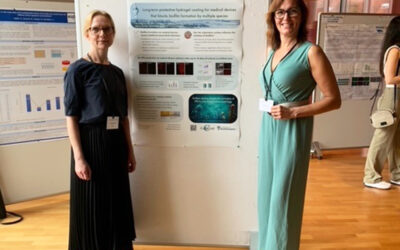
Poster presentation at EuroBioFilms 2024
Poster presentation at EuroBioFilms 2024 Linda Bergström (Program Manager and QA/RA) and Dr Ana Romero (Scientific Advisor) attended the EuroBioFilms 2024 conference in Copenhagen from 26th to 29th June and presented CytaCoat’s...
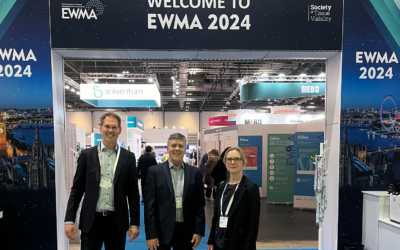
CytaCoat attended EWMA 2024 to progress wound care partnering and collaboration discussions
CytaCoat attended EWMA 2024 to progress wound care partnering and collaboration discussions Graeme Brookes (CEO), Per Wirsén (COO) and Linda Bergström (Program Manager and QA/RA) attended the European Wound Management...

CytaCoat attended Medica 2023 to progress partnering and collaboration discussions
CytaCoat attended Medica 2023 to progress partnering and collaboration discussions CytaCoat Chief Executive, Graeme Brookes and Chief Operating Officer, Per Wirsén enjoyed a successful Medica in Dusseldorf during 15 to 16...
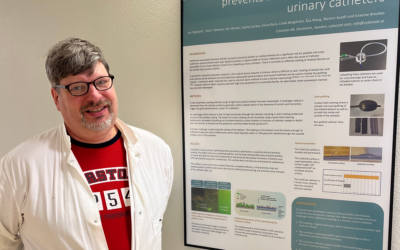
CytaCoat attends the 2023 Advanced Polymer Science and Engineering conference and makes poster presentation
CytaCoat attends the 2023 Advanced Polymer Science and Engineering conference and makes poster presentation CytaCoat’s Senior Chemist, Dr Jan Tejbrant, attended the 4th International Conference on Advanced Polymer Science and...
CytaCoat awarded a Seal of Excellence in EIC Accelerator
This project has received funding from the European Union’s Horizon 2020 research and innovation programme under grant agreement No 826846…

CytaCoat secured grant from Vinnova the Swedish innovation Agency
CytaCoat has secured four grants from Vinnova, the Swedish innovation agency, total amount of approximately €750 k. The latest grant was received in March 2020 (€160 k)…
CytaCoat AB, Maria Aspmans gata 44A, 171 64 Solna SWEDEN | E-mail info@cytacoat.se
Design LIVE Reklambyrå